

This page describes the overall process of IP.com’s Defensive Publishing where you can publish documents either immediately online to the Prior Art Database (PAD) or Print-only to The IP.com Journal. Defensive publications submitted online are available both in PAD as an electronic publication and as a standard listing in The IP.com Journal with the option to print the full disclosure in the Journal. For a Print-only submission, the publication will not appear online in PAD and will be published in full with no authorship information in The IP.com Journal. Timestamps are in UTC.
To learn more about the features and benefits of defensive publishing, click here.| Defensive Publishing | Prior Art Database (PAD) |
Guidelines for Preparing a Defensive Publication
An effective defensive publication concisely presents the novel idea, provides enough information to protect that idea, and validates that it is useful and non-obvious. An effective summary can be seven pages or less. For additional publishing rules, click How to Publish a Disclosure.
You do not need to prepare a perfect write-up on your own! IP.com’s Editing Services can help you develop a clear, useful, and discoverable document. To learn more, click IP.com Editing Services.
A voucher is required to publish prior art. If your account is out of Publishing Vouchers, your submissions will be accepted but cannot be published until enough vouchers have been purchased. For further details, click on the link Purchasing Defensive Publishing Vouchers.
Please contact our Support Team to submit a deferred submission. A deferred submission generates an email that the disclosure has been received but not published, and removing a deferred submission generates a confirmation email.
How to Publish
To learn how to publish a new document, click on the link How to Publish a Disclosure.
Online Publication Availability
Once an online publication is submitted, your document is usually published within minutes in the IP.com Prior Art Database (PAD); please be patient if there is an extended wait time which may happen on a rare occasion. The publication process creates digital fingerprints, bundles components into a downloadable zip file, and assigns a publication identifier. The publication zip file is validated through a third-party digital notarization process which transfers and stores notary information to the publication server. A typical disclosure publication generates two emails: one acknowledging receipt and one after notarization is complete.
For the full disclosure, including any attached files, you can access the data from an online application such as the Prior Art Database. To access electronic publications in PAD, enter the IP.com disclosure number or use a keyword or concept search. The Prior Art Database is also available as a content source selection in the InnovationQ+ Non-Patent Literature collection. To learn more about InnovationQ+, click here.
The IP.com Journal
As a final step of the Defensive Publishing process, you select the publishing options for your primary document. You can choose to have your document appear in The IP.com Journal as a standard listing, full listing, or print-only. For information about The IP.com Journal including content, availability, and distribution, click on the link The IP.com Journal – Contents, Availability, and Distribution.
Satisfying Legal Requirements
IP.com uses Surety, LLC for notarization of all the Prior Art documents submitted for publishing. Once the document has been indexed in our search server and registered on our public website, our external server (not located in our data center or at the provider of the PAD computing services) runs a process that checks to see if there are any new publicly available documents that need notarizing. The process will make a request to download the ZIP files for new publication from https://priorart.ip.com to ensure they were indeed publicly available. At this point, the ZIP file is notarized by Surety, LLC and we are issued a notarization record. This record becomes the actual timestamp and can be used for verification as to when the document was published.
You can also download a TSO file, an AbsoluteProof Envelope Formatted File, which contains the actual notarization record and can be validated by using the AbsoluteProof Viewer from Surety, LLC. The TSO file is included on optical media accompanying each issue of The IP.com Journal that is published twice monthly. For further information, click here.
An additional layer of validation is done by a process that runs periodically on our external server, located neither in our data center nor at the provider of the PAD computing services. This process re-downloads documents to assure they remain publicly available and unchanged.
Edit or Remove Publication
You are not allowed to edit a disclosure that has already been published, as the information in the disclosure is time-stamped and notarized to contain the information as of the publication date.
If your disclosure was published very recently and there is an error, you do have the option to have the document removed and re-published. If you want to add additional information to an older publication, you can publish a new disclosure and reference the previous version in the Add Related Documents field. To remove a disclosure, please reach out to our Support Team.
Search your Disclosures
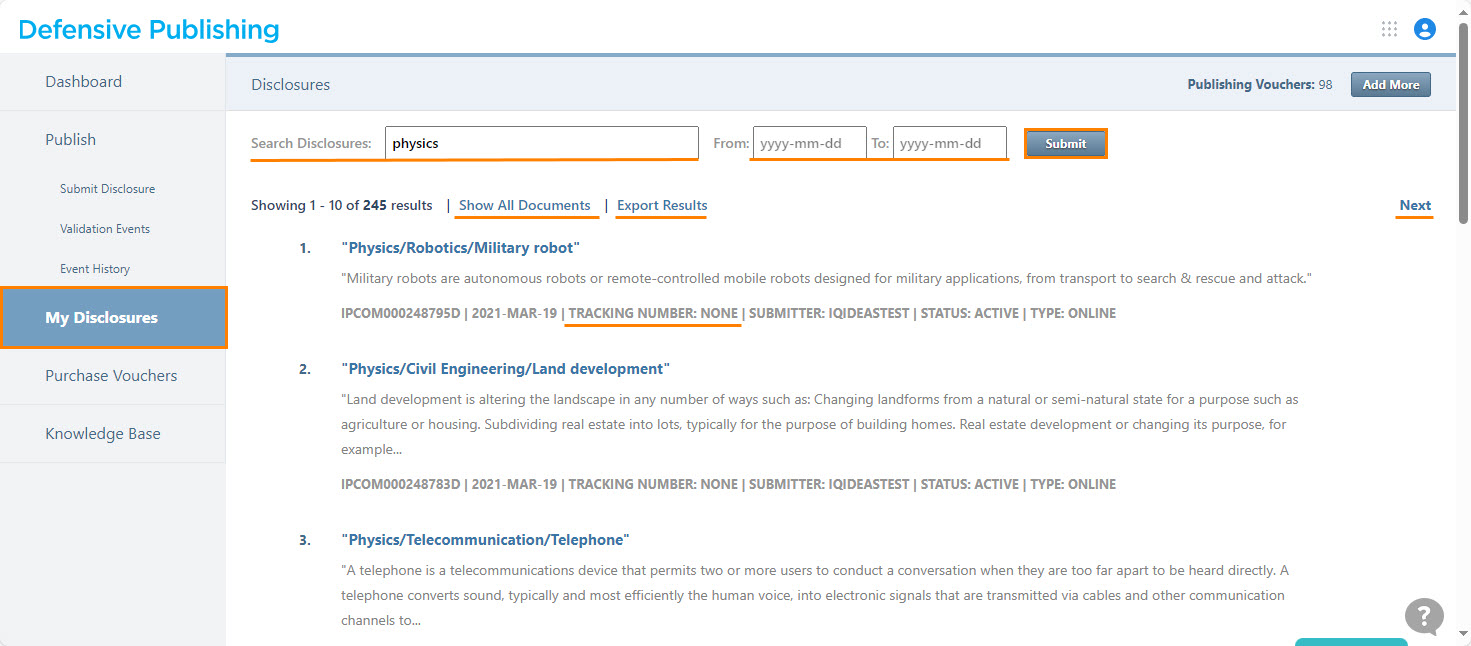
From the sidebar, select My Disclosures to search for disclosures published to the Prior Art Database by you or someone from your company.
You can search by Title, IPCOM#, Tracking Number, Author, or date range. A date range restriction can be included with another search type. To download the results to a CSV file, select Export Results. To view the next page of results, click Next. To reset the search filters, select Show All Documents.
For documents submitted by you, you can change the Tracking Number. The Type identifies whether the submission was published online or Print-only.
To view the publication in PAD, click on the title.
Related Articles
Introduction to Defensive Publishing and the Prior Art Database (PAD)Registering an IP.com Account and Accessing Solutions
Updating your Account Information
Publishing Disclosures to the Prior Art Database (PAD)
The IP.com Journal – Contents, Availability, and Distribution
Purchasing Defensive Publishing Vouchers
How to Publish a Disclosure
Searching the Prior Art Database (PAD)
Searching PAD Using Keywords
Searching PAD Using Concepts
Downloading Publications from the Prior Art Database (PAD)
FAQs
